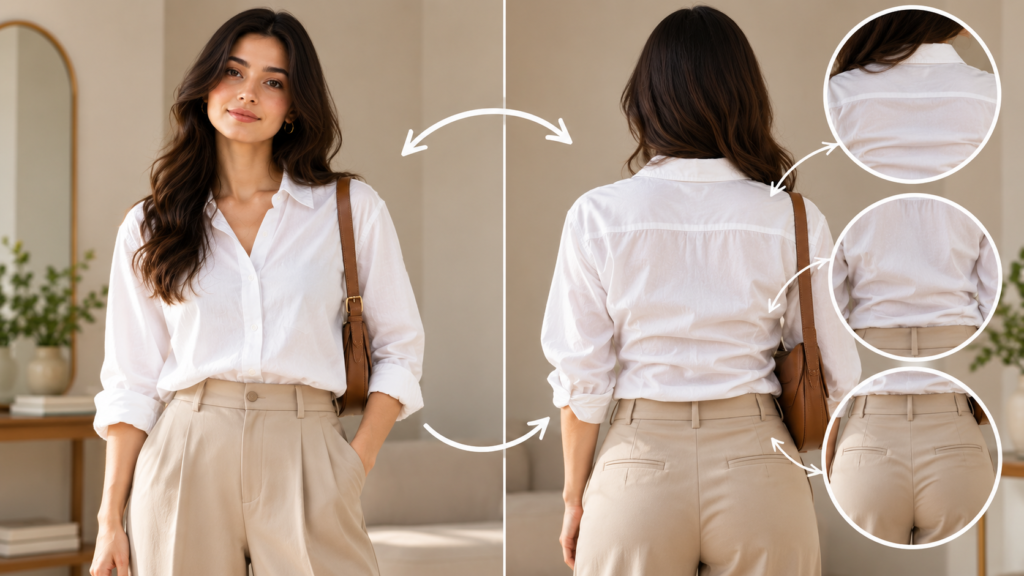
Why Your Clothes Look Fine From the Front but Wrong From the Back
Have you ever put on an outfit, looked in the mirror from the front, and thought everything looked perfectly fine, only to see a photo from behind and suddenly notice that something feels completely wrong? The neckline may look beautiful, the shoulders may seem balanced, the waist may appear smooth, and the overall silhouette may look flattering from the front. But from the back, you might suddenly notice strange wrinkles, fabric pulling across your shoulders, bunching around your waist, an uneven waistband, or excess fabric that makes the entire outfit look less polished. Sometimes the difference is so noticeable that you start wondering whether you chose the wrong size or whether the outfit simply doesn’t suit you. The frustrating part is that you may have done everything you normally do when checking your clothes—you looked in the mirror, adjusted the sleeves, checked the front, and made sure everything looked neat. The problem is that you were only checking one side of a garment that has to work around your entire body.
1. Your Clothes Are Designed for a 3D Body, Not Just the Front
Your body has different shapes, curves, and dimensions from every direction, and clothing has to accommodate all of them at the same time. The front of your body has the chest, stomach, and front waist, while the back has your shoulder blades, spine, lower-back curve, hips, and seat. These areas create different amounts of depth, and fabric has to travel around all of them. When you stand in front of a mirror, you can easily see whether the neckline is sitting correctly, whether buttons are lying flat, whether the front waist looks smooth, and whether your trousers appear balanced. What you cannot easily see is what the fabric is doing behind you. It may be stretching across your shoulder blades, collecting around your lower back, shifting upward, or developing tension around your hips. This is why a garment can appear completely correct from the front and still have several fit problems from behind. The front gives you useful information, but it never tells the entire story of how a garment is fitting your body.
2. Pulling Across the Back Can Be a Hidden Fit Problem
One of the most noticeable signs is repeated pulling across the back. You might see horizontal lines stretching across your upper back, diagonal wrinkles moving toward your shoulders, or folds appearing around your shoulder blades. Some wrinkles are completely normal because fabric naturally moves when you move your body. The difference is when the same lines repeatedly appear even when you are standing normally or return whenever you move into a particular position. The fabric may be trying to move in a direction that isn’t natural for the garment, creating visible tension across the back. Meanwhile, the front can remain surprisingly smooth because there may be enough room across the chest or stomach. This creates a very confusing situation: you look at the front and think the garment fits, but the back is showing that the fabric is working much harder than you realize. Over time, these repeated pulling lines can make a shirt, dress, jacket, or blouse look less polished even though the front still appears perfectly presentable.
3. Bunching Around the Lower Back Can Make Clothes Look Larger
Another common problem is fabric collecting around the lower back instead of falling smoothly. You may notice several horizontal folds, a loose-looking section around your waist, or a visible amount of fabric gathering at the back. This is particularly noticeable with longer shirts, sweaters, dresses, jackets, and fitted tops. When you see this, your first thought may be that the garment is simply too large. But the amount of fabric isn’t necessarily the entire explanation. Clothing has to follow the curve of your lower back and then transition toward your waist and hips. When the fabric can’t settle naturally along that path, it can gather into folds. The front can still look beautifully smooth because the front of your body has a different shape. This is why the same garment can look streamlined from the front and noticeably bulky from behind. The back bunching may also become more pronounced after sitting, walking, or moving, making the outfit look different throughout the day.
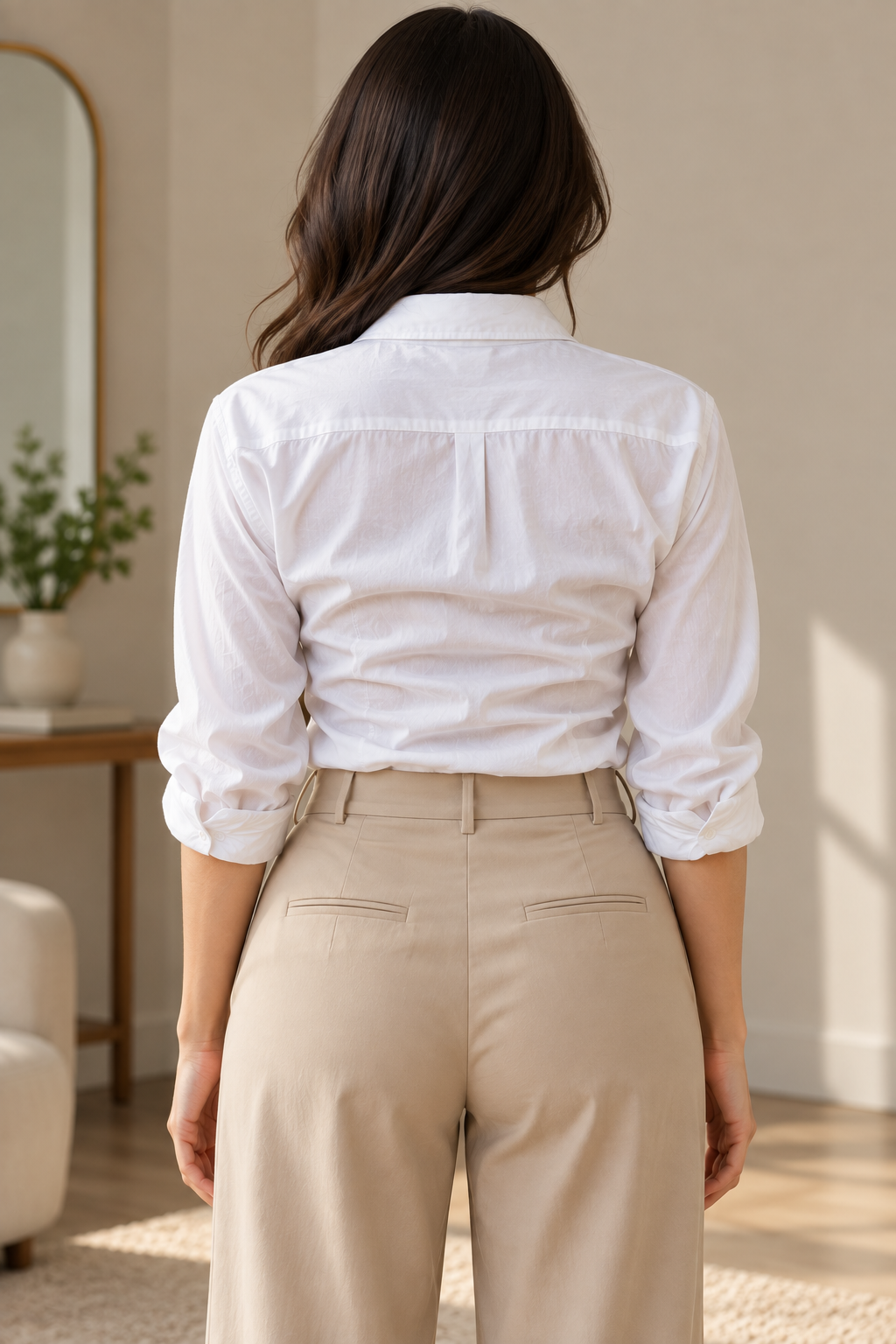
4. Why Your Top Keeps Riding Up at the Back
A top that constantly rides up can be one of the most frustrating clothing problems because you may spend the entire day adjusting it without understanding why it keeps happening. When you first put on the garment, the front and back may both appear to sit correctly. But after walking, sitting, bending, reaching forward, or moving your arms, the back begins to move upward. You pull it down again, continue with your day, and then notice that it has climbed up once more. Eventually, the garment may look shorter at the back while fabric gathers around the waist. This can happen with shirts, sweaters, blouses, dresses, and other garments that need to move over several different areas of the body. The problem can be especially noticeable when the front still looks completely normal. Because you don’t have a constant view of your back, you may not realize how much the garment has shifted until you see yourself in a photograph.
5. Your Shoulder Blades Affect More Than You Think
The shoulder-blade area is one of the most important but overlooked parts of clothing fit. Your shoulder blades aren’t flat surfaces, and they aren’t stationary either. They move whenever you reach forward, raise your arms, stretch, or rotate your shoulders. Clothing has to move with that changing shape. When it doesn’t, the fabric may create diagonal wrinkles, horizontal folds, or pulling around the upper back. You might notice that a shirt looks completely smooth while your arms are resting naturally but becomes distorted when you reach forward. A blazer may look sharp when your arms are down but pull between the shoulder blades when you move. A dress may look perfectly fitted from the front but develop folds across the back when you walk. This is why simply checking whether the shoulder seams look correct from the front isn’t always enough. The back has its own fitting requirements, especially when the garment is structured or relatively fitted.
6. Trousers Can Look Perfect From the Front but Wrong From Behind
Back-fit problems aren’t limited to tops. Jeans, trousers, skirts, and fitted bottoms can also create a completely different appearance from behind. A pair of trousers may look smooth across the front while developing folds underneath the seat, pulling around the hips, bunching across the upper thighs, or creating excess fabric around the back of the legs. The waistband can make the situation even more confusing. It may sit perfectly at the front while rising, dipping, folding, or gapping at the back. Because most people naturally check their trousers from the front when getting dressed, these problems can remain unnoticed for hours. Then a photo from behind suddenly reveals that the fabric isn’t falling the way you thought it was. The shape of your waist, hips, seat, and legs all affects how trousers behave, which means a clean front doesn’t automatically mean the entire pair is working correctly.
7. The Waistband Can Change the Way the Whole Garment Falls
The waistband deserves special attention because it acts as an important point between the upper and lower portions of many garments. If it sits differently at the front and back, it can influence everything below it. You might notice that the front waistband appears perfectly level while the back sits higher, lower, or slightly away from the body. Once that happens, the fabric underneath may begin to fold, pull, or gather. This can be especially visible with trousers, skirts, fitted dresses, and high-waisted styles. A small change around the waistband can therefore create what looks like a much bigger problem through the hips or lower back. This is another reason why looking at one wrinkle and trying to judge the entire garment from that wrinkle alone can be misleading. The fabric you see bunching lower down may actually be responding to something happening closer to the waist.
8. Fabric and Garment Construction Can Change Everything
The material of your clothing can make a fit issue either subtle or extremely obvious. Lightweight fabrics often reveal small changes in tension because they follow the body closely. Stiffer fabrics may resist movement and create stronger pulling lines when your body needs more freedom. Stretch fabrics can temporarily hide tension because they have the ability to expand, while heavier materials may create their own folds simply because of their weight. Then there is the construction of the garment itself. Seams, darts, panels, armholes, pleats, waistbands, vents, and other structural details determine how much fabric is available in different areas and how that fabric can move. This is why two garments in exactly the same size can behave completely differently on the same person. One may fall smoothly around the back while another may pull, bunch, or shift. The label inside your clothing tells you the size, but it doesn’t tell you how that particular garment will distribute its fabric around your body.
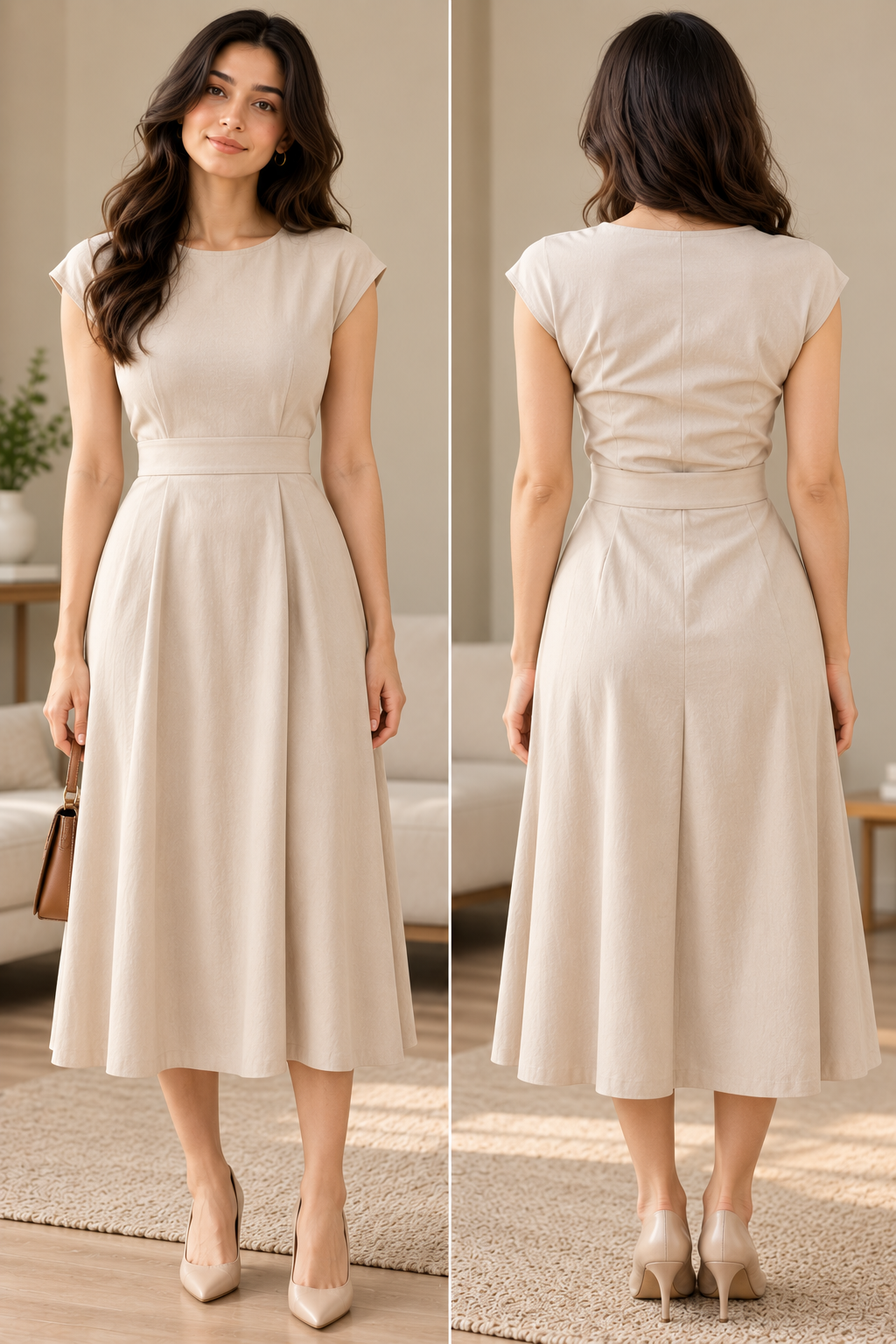
9. Movement Reveals Problems a Mirror Cannot Show
A garment isn’t worn while you’re standing completely still, yet that’s often the exact position in which people judge their clothes. You put something on, stand in front of the mirror, look at the front, adjust a few things, and decide that the outfit works. But throughout the day you are constantly moving. You walk, sit, bend, reach, carry things, raise your arms, lean forward, turn around, and change positions. Every movement changes how fabric interacts with your body. A shirt may look smooth when you’re standing but pull across your back when you reach forward. A dress may look perfectly positioned while you’re upright but ride upward when you sit. A blazer may look tailored when your arms are down but develop folds when you move them. Trousers may look clean in the mirror but bunch underneath when you walk. These changes are important because they show that clothing fit isn’t just about appearance in one stationary position. How the fabric behaves during normal movement can reveal problems that you simply cannot see from a front-facing mirror.
10. Photos Can Reveal the Fit Problems You Never Notice Yourself
This is why outfit photographs can sometimes feel surprisingly brutal. You may look at yourself in the mirror before leaving home and feel completely confident, then see a picture taken from behind and immediately notice something you had never seen before. The photo may show fabric gathering around your waist, wrinkles across your back, an uneven waistband, or trousers bunching in a particular area. The clothing hasn’t suddenly changed. You are simply seeing the garment from a direction that your mirror normally doesn’t show you. Photos can also capture you while you’re moving, sitting, turning, or standing naturally rather than posing directly toward a mirror. That can reveal how the clothing actually behaves in everyday situations. Instead of treating every unexpected wrinkle in a photograph as a sign that your body looks wrong, it’s more useful to recognize that the image may simply be revealing information about the garment that you weren’t able to see before.
11. A Different Size Isn’t Always the Answer
When people notice back pulling or bunching, their first instinct is often to change the size. Sometimes that may help, but size alone doesn’t explain every fit problem. Going up a size can create more room in one area while leaving excess fabric in another. Going down a size can make the front appear more fitted while increasing tension across the back. You can therefore end up solving one visible symptom while creating another. This is why the relationship between the garment’s shape and your body is more important than simply looking at the number on the label. Two garments with the same size can have completely different proportions, construction, fabric behavior, and distribution of space. The goal of understanding fit is not simply to find a bigger or smaller number. It is to understand why the fabric is behaving the way it is behaving in the first place.
Conclusion
When your clothes look fine from the front but wrong from the back, there is usually more going on than a simple “bad fit.” Your body has different shapes from every direction, and your clothes have to move around all of those shapes while also allowing you to move naturally. Pulling across the shoulders, bunching around the lower back, an uneven waistband, fabric riding upward, wrinkles around the hips, or trousers gathering underneath can all change the appearance of an outfit even when the front looks completely polished. These problems can also become more obvious depending on the fabric, construction, proportions, and movement of the garment.
The important thing is to stop thinking about clothing as something that only needs to look good from the front. A truly balanced outfit has to work as a complete 360-degree silhouette. Once you start paying attention to what happens behind you, you may discover that many outfits you previously considered “unflattering” were actually showing specific fit problems that could be understood much more precisely.
✨ Ready to Fix Your 360° Fit?
If your clothes look perfect from the front but pull, bunch, wrinkle, shift, or sit strangely from behind, The 360° Fit Fix takes you deeper into the hidden fit problems that affect your clothes from every angle.