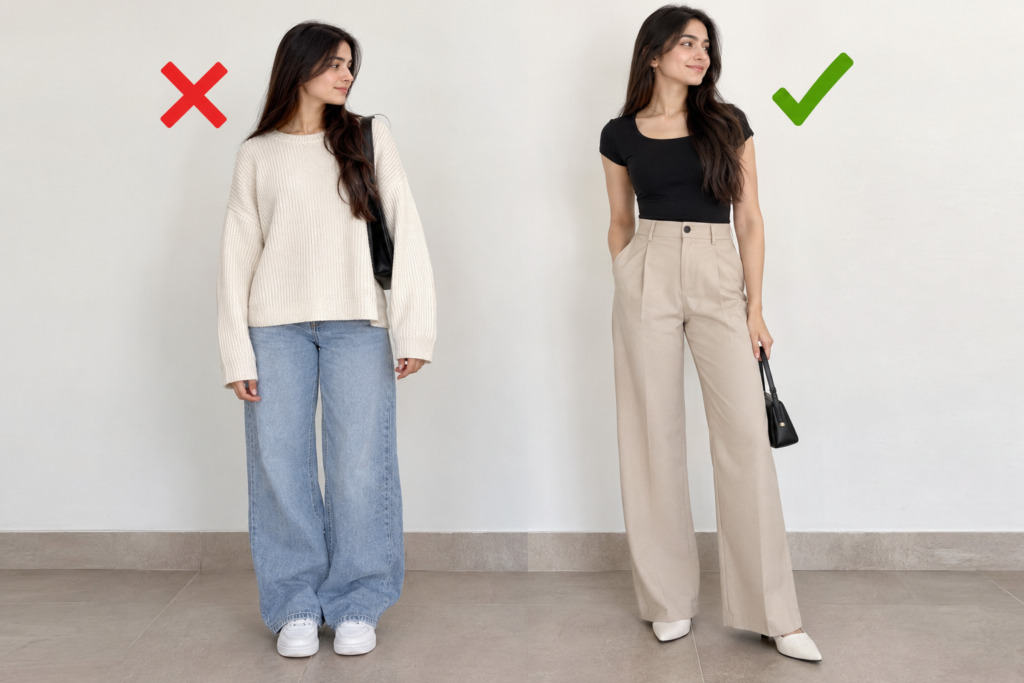
Have you ever worn an outfit that technically fits perfectly, yet when you look in the mirror, something feels slightly wrong? The clothes aren’t too tight, they’re not obviously oversized, and there doesn’t seem to be any major styling mistake. Still, the overall look can make your body appear more compact than you expected. This is one of the most confusing parts of getting dressed because we are taught to judge clothes individually: does the shirt fit, do the trousers fit, do the shoes look good? But the eye doesn’t see an outfit as separate products. It sees one complete image. And the way those individual pieces interact can change how your proportions are perceived.
The interesting thing is that looking shorter is not always caused by clothing being the wrong size. In many cases, the issue is visual organization. Clothing creates boundaries, interruptions, shapes and areas of emphasis around your body. Your eyes naturally interpret these elements and use them to understand the proportions of what they are looking at. When those elements work together, an outfit can feel balanced and coherent. When they compete with one another, the same body can suddenly look more compressed, wider or less elongated.
The Difference Between Fit and Visual Proportion
Fit answers a very practical question: does the garment sit correctly on your body? Visual proportion asks something different: how does that garment affect the relationship between the different parts of your body once the entire outfit is visible?
A pair of trousers can fit perfectly around your waist and legs while still creating an appearance that makes your lower body seem shorter. A jacket can sit correctly across your shoulders but change the apparent relationship between your torso and legs. A dress can be the correct size but create a silhouette that feels visually divided. None of these situations means the garment is badly made or that your body is shaped incorrectly. It simply means fit and proportion are two different things.
This distinction is incredibly useful because it changes the way you troubleshoot an outfit. Instead of immediately thinking, “I need a different size,” you can start asking, “What is this garment doing to the overall shape?” That question leads to much better styling decisions.
Your Eye Doesn’t Read Clothing Piece by Piece
When you look at yourself in a mirror, you might notice your top first and then your trousers, followed by your shoes. But your brain is also processing the entire silhouette at once. It notices where one color ends and another begins, where fabric changes direction, where a layer finishes, where volume increases, and where the strongest visual details are located.
Imagine looking at a person wearing an outfit made up of several strongly contrasting sections. Your attention might move from the face to the top, then sharply to the waist, then to the trousers, then to the shoes. The body becomes visually separated into different zones. Now imagine an outfit in which the different elements feel more connected. Your eye can move through the outfit more naturally because there are fewer competing interruptions.
This is one reason an outfit can make someone appear visually longer without changing anything about their actual height. The perception of length comes partly from how smoothly the eye travels through the complete look.
Why “Perfectly Fitted” Clothes Can Still Feel Wrong
There is a common assumption that if clothes fit properly, the outfit should automatically look flattering. In reality, several perfectly fitted garments can create a poor combination.
Think about buying furniture for a room. A sofa might be beautiful. A table might be beautiful. A chair might be beautiful. But putting all three together doesn’t automatically create a beautiful room. Their scale, spacing, shape and relationship with one another still matter.
Clothing works in much the same way.
A top might have exactly the right shoulder width. Your trousers might have exactly the right waist size. Your jacket might fit perfectly. Yet if all three create competing shapes, the final silhouette may feel visually heavy or fragmented. The problem isn’t any single garment. The problem is the conversation happening between them.
This is why experienced styling often looks effortless. The clothes aren’t necessarily extraordinary. They simply make sense together.
The Hidden Effect of Horizontal Interruptions
One of the easiest ways an outfit can visually interrupt the body is through strong horizontal divisions. Every time a garment ends, a color changes, a layer overlaps another, or an accessory creates a strong boundary, the eye receives another piece of information.
Some horizontal elements are necessary and beautiful. A waistband, jacket hem or skirt hem can give an outfit structure. The problem appears when too many strong divisions happen close together.
Imagine looking at a simple vertical shape and then drawing several bold lines across it. The eye begins to notice the sections rather than the complete length. Clothing can create a similar effect on the body.
This doesn’t mean you should avoid horizontal details. Fashion would be incredibly boring if that were the rule. The point is to understand that every strong line has a visual effect, and the more noticeable those effects become, the more they influence the overall silhouette.
Why Layering Can Change Your Entire Appearance
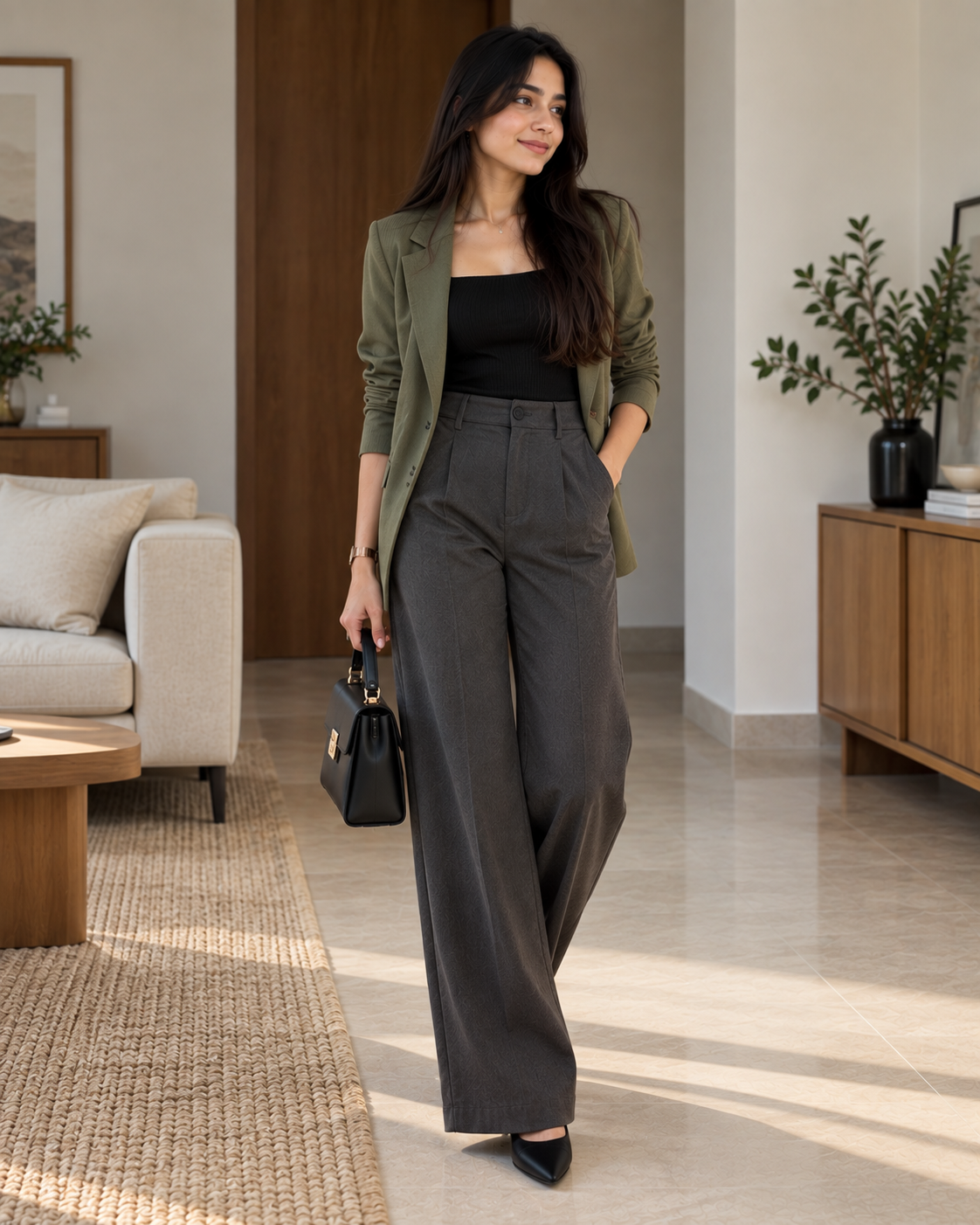
Layering is one of the most useful tools in fashion, but it can also completely change the perceived scale of an outfit. Adding a cardigan, jacket, overshirt or coat introduces another outline around your body. Add another layer, and you introduce another shape.
When layering is intentional, this creates depth and sophistication. When the layers all have significant volume, the body can start disappearing underneath them. The clothing becomes the dominant shape rather than the person wearing it.
This is especially noticeable when multiple pieces have similar visual weight. A thick top under a thick jacket combined with substantial trousers can create a lot of material around the body. The clothes may still fit, but the silhouette becomes heavier.
Good layering isn’t necessarily about using fewer layers. It’s about understanding which layer should establish the main shape and which layers should support it.
The Role of Fabric and Texture
Something else that often gets ignored is fabric.
Two garments with exactly the same cut can create very different impressions because one fabric is fluid and another is structured. Thick knits, heavy denim, stiff outerwear and bulky textures naturally occupy more visual space than lighter, smoother materials.
Texture also attracts attention. A heavily textured garment can become a focal point even when its shape is simple. If several textured pieces are combined, the outfit can become visually dense.
This doesn’t make heavy fabrics bad. In fact, they can create beautiful structure and character. But if your goal is to create a lighter, more elongated impression, understanding fabric weight becomes important.
Sometimes the problem isn’t what you’re wearing. It’s the amount of visual weight that the material is adding.
Why the Same Outfit Can Look Different on Different People
This is where personal proportions become important.
An outfit doesn’t exist in isolation. It interacts with the person wearing it. The same jacket length, trouser shape or dress silhouette can create different visual results depending on someone’s proportions, posture and overall frame.
That doesn’t mean there is one universally “correct” outfit for every body. There isn’t.
It means that styling becomes more effective when you stop copying an outfit exactly as you saw it and instead understand what that outfit was trying to achieve.
Maybe the original look worked because of the relationship between its shapes. You don’t necessarily need the identical pieces to recreate that effect. You need to understand the visual principle behind the combination and adapt it to yourself.
That’s the difference between copying fashion and actually learning style.
The Camera Can Make the Problem Look Worse
There is another reason people sometimes believe an outfit makes them look shorter: photographs are not neutral representations of the body.
Camera height, lens choice, distance from the camera, posture and even the angle of the phone can influence proportions. A camera positioned too close can exaggerate certain areas. A photograph taken from above or below can alter the apparent relationship between different parts of the body.
This is particularly important when judging outfits from social media.
A look that appears incredibly elongated in a carefully composed photograph may not produce exactly the same effect in everyday life. The image may have been created with a specific pose, camera position, lighting setup and editing style.
So if an outfit looks different in your own photograph, don’t immediately assume the clothes are the problem.
The camera is part of the equation too.
Why Trends Don’t Always Translate to Your Wardrobe
Fashion trends are designed to attract attention, but a trend isn’t automatically compatible with every wardrobe or every personal preference.
An oversized silhouette might look fantastic in an editorial because everything around it has been carefully controlled. A particular trouser shape may work beautifully when styled with the exact shoes, top and outerwear chosen for the look. A dramatic jacket may look effortless because the rest of the outfit has been deliberately kept quiet.
When we copy only one element of that look, we can accidentally remove the context that made it work.
That’s why blindly purchasing “trendy” pieces can create frustration. You may own fashionable clothes but still struggle to build outfits that feel balanced.
The better approach is to ask yourself what attracted you to the look in the first place. Was it the relaxed feeling? The elegance? The simplicity? The strong silhouette? The color combination?
Once you understand the appeal, you can recreate the idea rather than simply copying the clothes.
Your Wardrobe Doesn’t Need to Be Bigger
A surprisingly large number of styling problems are treated as shopping problems.
Something feels wrong, so we buy another pair of trousers.
The wardrobe feels boring, so we buy another jacket.
An outfit doesn’t feel flattering, so we buy another top.
Eventually the wardrobe becomes crowded, but getting dressed doesn’t become easier.
The reason is simple: more clothes don’t automatically create more useful combinations.
Sometimes what you actually need is a better understanding of the pieces you already have. A garment that seems boring on its own can become completely different when combined with another piece. An item you stopped wearing might work beautifully in a new context.
Before buying something new, experiment with what you already own. Change the surrounding pieces. Remove something. Add something. Try the outfit with different footwear. Wear it in a completely different way.
You may discover that your wardrobe wasn’t lacking clothes.
It was lacking new combinations.
The Most Important Question Isn’t “Does This Make Me Look Taller?”
This might sound strange considering the subject of this article, but focusing obsessively on looking taller can actually make styling less enjoyable.
A better question is:
“Does this outfit create the impression I want?”
Maybe you want to look elegant. Maybe you want to look relaxed. Maybe you want to look modern, powerful, soft, creative or sophisticated.
Height is only one part of visual presentation.
Once you understand how proportion works, you gain the ability to decide when you want to emphasize length and when you don’t. You can intentionally choose something dramatic, oversized or highly contrasting because you like the effect.
That’s real styling freedom.
The purpose of understanding proportions isn’t to give you a list of clothes you’re “allowed” or “not allowed” to wear. It’s to help you understand the visual consequences of your choices.
The Shift From Dressing Your Body to Designing Your Look
Perhaps the biggest change happens when you stop treating clothing as something that simply covers your body.
Clothing can create shape.
It can create rhythm.
It can create emphasis.
It can create contrast.
It can create movement.
And it can influence where another person’s attention naturally goes.
Once you start seeing clothes this way, getting dressed becomes almost like designing a composition. You begin noticing relationships that you previously ignored: how one piece interacts with another, how a certain material changes the visual weight of an outfit, how a small detail can become the focal point, and how removing one element can sometimes make the entire look stronger.
You don’t need to become a fashion expert to do this.
You simply need to become more observant.
So, Why Do Some Outfits Make You Look Shorter?
Usually, it isn’t because the clothes are “bad.”
It isn’t necessarily because they don’t fit.
And it certainly isn’t because your body needs to change.
More often, the outfit is creating a visual structure that emphasizes width, divides the body into noticeable sections, adds too much visual weight, or makes the eye repeatedly stop instead of moving naturally through the entire silhouette.
Once you understand that, you can stop judging clothes individually and start judging the relationship between them.
That one shift can completely change the way you shop, dress and look at your own wardrobe.
The goal isn’t to make every outfit look taller.
The goal is to understand why an outfit creates the impression it does—and then decide whether that is the impression you actually want.
Take Your Styling Further
If this changed the way you think about your clothes, there’s much more you can explore.
The Outfit Tricks That Make You Look Taller is a practical guide that goes deeper into the visual principles behind creating a longer, more balanced silhouette, with dedicated guidance across different parts of an outfit and wardrobe.
Ready to stop guessing and start understanding why an outfit works?
👉 Get your copy of The Outfit Tricks That Make You Look Taller and turn the clothes you already own into smarter, more intentional outfits.
Pingback: Why Your Sweater Makes You Look Bigger Than You Are - Best for 2026