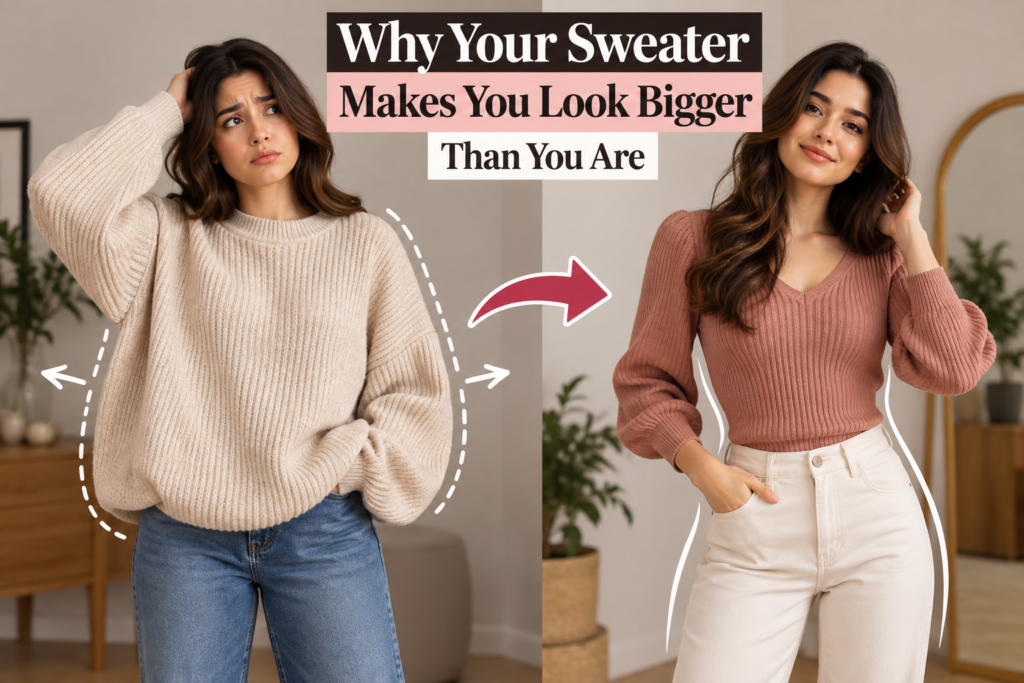
Why Your Sweater Makes You Look Bigger Than You Are
Have you ever bought a sweater that looked absolutely perfect when you saw it online or hanging in a store, but the moment you put it on, something felt completely different? The color looked beautiful, the knit looked expensive, and the sweater itself seemed fashionable, yet your body suddenly appeared wider, your waist seemed to disappear, your torso looked shorter, or the whole outfit felt heavier than you expected. You may even have changed your jeans, tried another pair of shoes, or gone up and down a size, but still couldn’t figure out why the sweater wasn’t giving you the effortless look you imagined. The frustrating truth is that this usually has much less to do with your body and much more to do with the silhouette the sweater creates around your body.
A sweater doesn’t simply cover your body. Because of its thickness, texture, construction, and volume, it can actually create a new outer shape around you. That outer shape is what the eye notices first. This is why a person can have exactly the same body measurements but look noticeably different in a fitted top versus a chunky sweater. The body hasn’t changed, but the visual boundaries around it have. Understanding that difference is important because otherwise it’s very easy to blame yourself for a problem that is actually coming from the garment.
1. Your Sweater May Be Adding Width Where Your Body Doesn’t Have It
One of the biggest reasons a sweater can make you appear bigger is simple: the garment itself may extend farther outward than your natural body shape. Lightweight clothing tends to stay relatively close to the body, but knitwear often has enough thickness and structure to create space between your body and the outside edge of the garment.
Imagine looking at someone from a distance. You don’t see their exact measurements. You see the outside outline of their clothes. If a sweater extends several centimeters beyond the body’s natural sides, that additional space becomes part of the perceived silhouette. This is why an oversized sweater can make your frame look noticeably wider even when the sweater doesn’t feel particularly heavy while you’re wearing it.
The effect becomes stronger when the sweater has multiple sources of volume at once. A loose torso combined with dropped shoulders, wide sleeves, and thick fabric doesn’t simply make one part of the body look larger. It can make the entire upper half appear more substantial.
2. The Sweater’s Length Can Change Your Entire Body Proportion
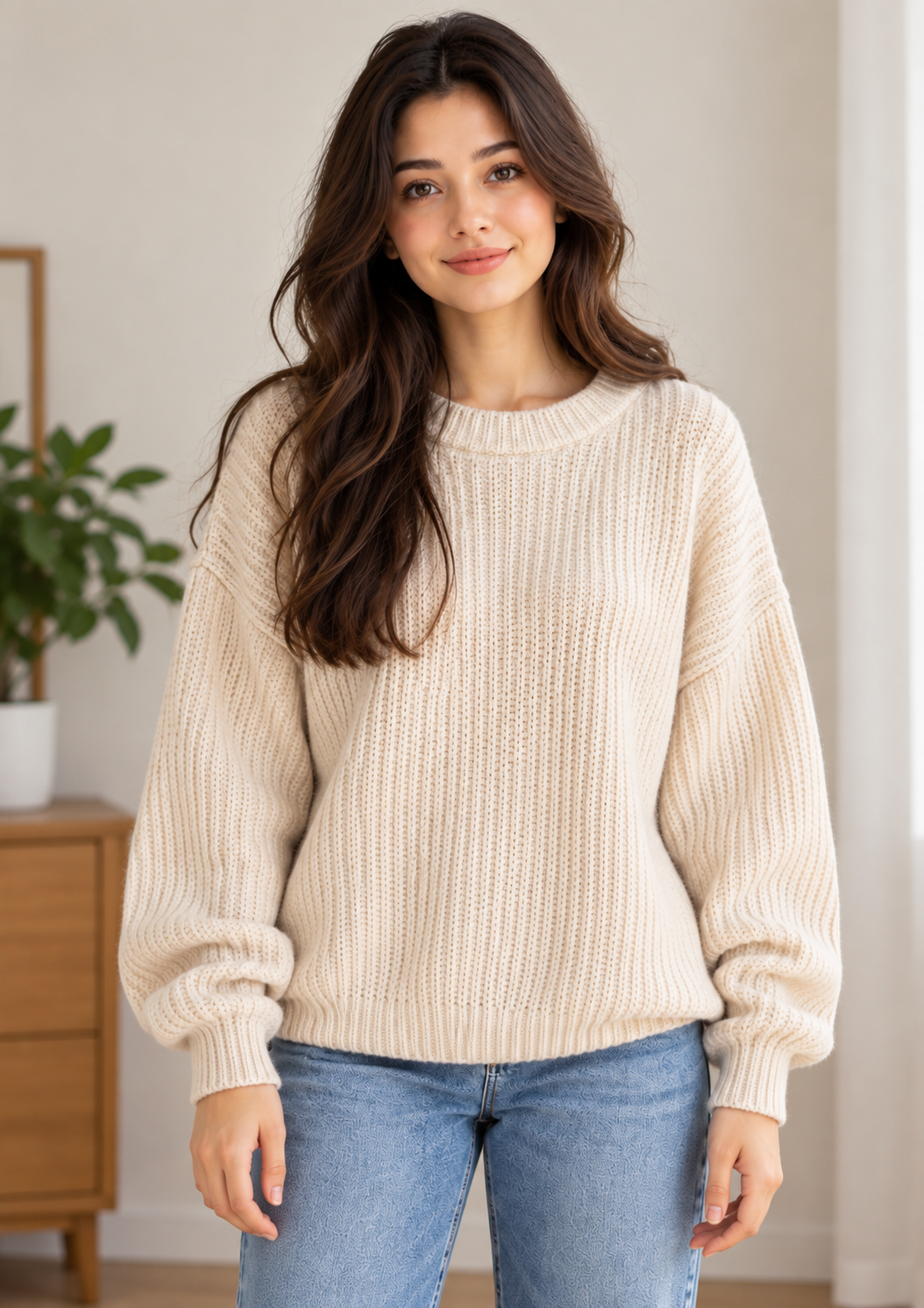
Length is one of the most underestimated details in sweater styling. People often look at a sweater and think about its size, color, neckline, or pattern, but rarely think about exactly where the hem will sit on their body.
Yet the hem creates a strong horizontal visual line. Wherever that line falls, it can attract attention to that particular section of the body. If the sweater ends around an area that is naturally wider, the eye may perceive that width more strongly. A longer sweater can also cover the transition between your torso and legs, making your body look less segmented and your legs appear comparatively shorter.
This is why a sweater that looks perfectly normal on a model may look dramatically different on you. The model’s height, torso length, hip placement, and proportions determine where the sweater’s hem falls. The exact same garment can land at a completely different visual point on another body.
3. Your Waist Can Completely Disappear
Your waist is one of the most important visual reference points in your silhouette. It gives the eye information about how your shoulders, torso, and hips relate to one another. When a sweater covers that area with a straight or boxy shape, those proportions become much harder to see.
Instead of visually reading:
shoulders → narrower waist → hips
the eye may read:
shoulders → continuous fabric → hips
That creates a much straighter silhouette.
This doesn’t mean your waist has actually disappeared. It’s still there physically. It’s simply hidden from view by the garment’s shape. And because the eye can’t clearly identify that narrower point, your entire torso may appear broader than it actually is.
4. Oversized Sweaters Can Create “Fabric First, Body Second”
Oversized fashion is popular because it looks relaxed, modern, and effortless. But the larger the garment becomes, the more the garment itself starts to dominate the visual impression.
Instead of seeing the body first and the clothing second, the viewer may see the sweater’s shape first.
This becomes particularly noticeable when the sweater has excess fabric around the chest, stomach, arms, and hips simultaneously. There are no obvious visual breaks, so the sweater becomes one large mass of fabric surrounding the body.
That’s why oversized doesn’t always mean flattering or unflattering. The important issue is where the extra volume exists and how much of the body it visually covers.
5. Chunky Knitwear Creates Physical and Visual Bulk
A chunky sweater doesn’t just look thicker—it actually occupies more space.
A fine-gauge knit can sit relatively close to the body, while a chunky knit may have substantial depth because of its yarn, stitch pattern, and construction. When you add cable patterns, raised textures, thick ribs, or fuzzy fibers, the garment gains even more visual dimension.
Texture matters because it changes how light interacts with the garment. Raised stitches create shadows and highlights, making the surface appear more three-dimensional. Fuzzy fabrics soften the outline but can also make the garment look larger and more cloud-like.
So sometimes you aren’t looking at a sweater that is technically oversized. You’re looking at a sweater whose fabric naturally creates more visual mass.
6. The Neckline Can Make Your Upper Body Look Heavier
The neckline may seem like a small design detail, but it controls one of the most noticeable areas of the sweater: your neck, shoulders, and upper chest.
A thick turtleneck, for example, places a significant amount of fabric around the neck. If that fabric is combined with a heavy knit and broad shoulder construction, the upper body can appear more compact and substantial.
A neckline also changes how much open space is visible around the face and upper chest. When that space is reduced by thick or high fabric, the sweater can visually occupy more of the upper body.
This doesn’t mean one neckline is universally better than another. The important point is that different necklines create different visual proportions.
7. Your Sleeves Might Be Making the Sweater Look Much Bigger
People often inspect the front of a sweater and forget to look at the sleeves. But sleeves can completely change the apparent size of a garment.
A sleeve that is extremely wide creates horizontal volume around the arms. A sleeve that is extremely long creates additional vertical fabric. A dropped shoulder pushes the sleeve attachment farther down the arm. When all three happen together, the sweater can look dramatically larger.
Large cuffs can add even more weight around the wrists. And when the sleeves cover part of your hands, the body loses another natural visual break.
This is why sometimes the torso of a sweater looks perfectly acceptable, but the outfit still feels overwhelmingly oversized. The problem may actually be coming from the amount of fabric around your arms.
8. Drop Shoulders Can Change the Apparent Width of Your Frame
Modern oversized sweaters frequently use dropped shoulder seams because they create a relaxed, slouchy shape. Instead of ending at the natural shoulder point, the seam falls farther down the arm.
That construction changes the visual boundary of your shoulders.
If the sweater is already wide through the body and the sleeves are large, the dropped seam can make the upper body appear to extend outward even farther. The result can be a softer but broader silhouette.
This is particularly noticeable in photographs because the camera captures the outer edge of the clothing very clearly.
9. Your Sweater May Be Making Your Torso Look Shorter
Looking bigger isn’t always about actual width. Sometimes the sweater changes your vertical proportions.
When a sweater creates one large uninterrupted section across your torso, the eye has fewer places to distinguish where your waist ends and your legs begin. This can make the upper body appear visually longer while the legs appear shorter.
A sweater can therefore create two problems at the same time: it can make you appear wider and shorter.
That’s why you may look at yourself and think, “Something about this outfit is making me look heavier,” when the real issue is partly a change in vertical proportion.
10. Tucking Thick Knitwear Can Create a Concentration of Bulk
Tucking is particularly complicated with sweaters because knitwear doesn’t behave like a lightweight shirt.
A thin top can disappear relatively easily into a waistband. A thick sweater cannot. When substantial knit fabric is pushed into trousers or jeans, it has to compress somewhere.
That compression can create visible bunching around the waist and stomach. Instead of one smooth transition between the top and bottom, the outfit can develop a thicker area exactly around the middle.
This is one of those situations where the styling idea sounds simple but the physical properties of the garment create a completely different result.
11. Your Bottoms Can Make the Sweater Look Even Bigger
A sweater can appear relatively balanced with one type of bottom and overwhelmingly bulky with another.
That’s because the eye doesn’t evaluate the sweater separately. It evaluates the relationship between the upper and lower parts of the outfit.
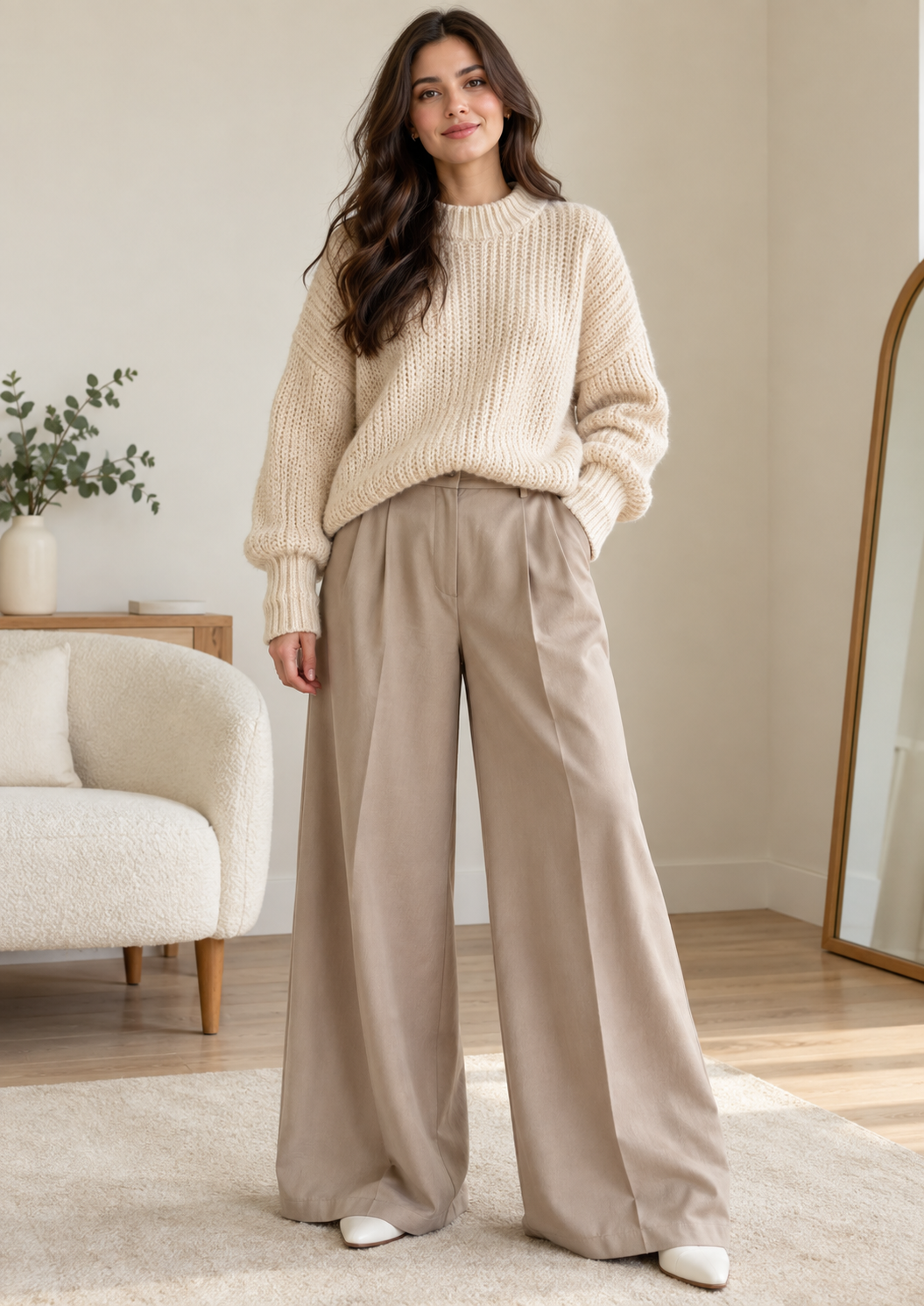
When both halves contain significant volume, the boundaries between them become less obvious. An oversized sweater combined with very wide trousers, for example, can create a continuous relaxed silhouette from shoulders to ankles.
Neither item has to be objectively “too big.” The issue comes from the combined visual volume.
12. Layering Can Multiply the Bulk
One of the easiest ways to accidentally create a bulky sweater outfit is to think about each layer separately.
You might have a shirt that looks perfectly fine on its own, a sweater that looks perfectly fine on its own, and a jacket that looks perfectly fine on its own. But when all three are combined, the total thickness around your torso and arms can become significantly greater.
The shoulders can become wider. The chest can become thicker. The sleeves can become heavier. The waist can become less visible.
This is why layering isn’t simply about adding more clothes. Every layer changes the outer architecture of the outfit.
13. Multiple Horizontal Lines Can Fragment Your Body
Layering can also create a different problem: too many horizontal lines.
Imagine seeing the edge of a shirt underneath the sweater, then the sweater hem, then the waistband of your trousers, followed by the hem of a jacket or coat. Each line divides the body visually.
When these lines appear in unfortunate places, the torso can look shorter and the overall silhouette can look wider or more fragmented.
The clothes may still be fashionable individually, but together they can create competing visual breaks.
14. Your Sweater May Be Too Boxy Even If the Size Is Correct
A sweater doesn’t have to be oversized to look boxy.
A garment can fit correctly according to its measurements and still have a straight, rectangular construction. The shoulders, torso, and hem may all have relatively similar widths, leaving very little indication of the body’s natural curves.
This is especially common in intentionally relaxed sweater designs.
The result is a silhouette that looks more like a rectangle around the body than a garment following the body’s natural structure.
15. Going Down a Size Doesn’t Automatically Solve the Problem
When a sweater makes you look bigger, it’s tempting to assume that the answer is simply buying one size smaller.
But the number on the label doesn’t determine the sweater’s silhouette.
A smaller sweater can still have heavy fabric, wide sleeves, dropped shoulders, a boxy shape, or a long hem. In some cases, reducing the size simply makes the sweater tighter without removing the visual characteristics that were creating the problem.
That’s why the issue isn’t really “What size am I?”
It’s “What shape is this garment creating around me?”
16. Why the Same Sweater Looks Amazing on Someone Else
This is one of the biggest sources of frustration when shopping online.
You see someone wearing a beautiful oversized sweater and think, “That would look amazing on me.”
Then you buy it, put it on, and wonder what happened.
The answer isn’t necessarily that the other person has a “better” body for sweaters. Their height, shoulder width, torso length, waist position, hip placement, and overall proportions may simply interact differently with the garment.
The sweater’s hem may land at a different point. The sleeves may have a different visual effect. The shoulder seams may sit differently. The same amount of fabric can create a completely different silhouette on two different bodies.
17. Why Your Sweater Looks Better on the Hanger
A hanger doesn’t have a body.
It doesn’t have curves, shoulders, hips, a waist, or a specific height. It simply displays the garment’s intended shape.
That’s why a sweater can look beautifully structured in a store and then feel completely different once you wear it.
On the hanger, you are judging the sweater as an object.
On your body, you’re seeing an interaction between the sweater’s design and your proportions.
That distinction explains why loving a sweater visually doesn’t always mean loving the way it looks when worn.
18. The Real Problem Isn’t Your Body—It’s the Visual Relationship
When a sweater makes you look bigger, it’s very easy to immediately think:
“Maybe my body doesn’t suit sweaters.”
But that’s often the wrong conclusion.
The sweater may simply be creating more width, hiding your waist, shortening your visual proportions, concentrating fabric in one area, or combining too much volume with the rest of your outfit.
Your body hasn’t become bigger.
The visual relationship between your body and the garment has changed.
Once you understand that, the problem becomes much more specific—and much easier to analyze.
Conclusion: It’s the Silhouette, Not Your Size
A sweater can make you appear bigger than you are because of a combination of factors rather than one obvious mistake. Length, fabric thickness, oversized volume, shoulder construction, neckline, sleeve width, waist visibility, tucking, layering, and the proportions of your bottoms can all influence the final silhouette.
That’s why simply buying a different size doesn’t always work. And it’s why a sweater that looks beautiful on a hanger—or even on another person—can create a completely different effect on you.
The important thing is to stop looking at the sweater only as a piece of clothing and start noticing the shape it creates around your body.
And once you can identify exactly where that extra visual bulk is coming from, you can finally understand what needs to change.
Ready to Fix Your Sweater Silhouette?
If you’re tired of sweaters making you look wider, shorter, or more bulky than you actually are, learn how to understand and control the proportions that create that effect.
✨The Sweater Silhouette Fix: Master Length, Volume, Tucking & Layering takes you from identifying the problem to understanding the practical styling fixes.
Pingback: Why Your Clothes Look Fine From the Front but Wrong From the Back - Best for 2026